
Bringing Montessori home does not require a full renovation or a room full of specialty furniture. A Montessori home environment starts with a few small, low-cost changes: a low shelf in the bedroom, a step stool in the kitchen, and a rotating basket of toys in the playroom. These simple shifts help toddlers and preschoolers make their own choices, do everyday tasks for themselves, and feel genuinely capable at home.
Key Takeaways
- Small, low-cost changes, a low shelf, a step stool, and one accessible drawer make the most significant difference at home.
- A “yes space” lets your child explore safely without hearing “no” all day long.
- Keeping only a few toys out at a time helps children focus and play more creatively.
- Kitchen and bathroom tasks like pouring water or washing hands build real skills, not just busywork.
- Start with one room or one shelf, then build from there over time.
What a Montessori Home Environment Actually Looks Like
A Montessori home environment is not a scaled-down classroom. It simply means arranging a few corners of your house so your child can reach, use, and put away things on their own. Think of one low shelf or a step stool, not a full room redesign. The American Montessori Society describes this approach as meeting children where they are developmentally, at home just as much as at school.
Parents often picture wooden trays and matching baskets when they hear “Montessori home.” In reality, most families start with what they already own. A bookshelf gets moved lower. A drawer gets cleared out for small hands. That is the main idea.
For a closer look at why Montessori classrooms are arranged the way they are-calm, orderly, and sized for small hands-read our companion article on the Montessori prepared environment. This piece focuses on the practical side: what you can actually change at home this week.
In our own Toddler and Primary classrooms here in Chula Vista, we notice how much calmer and more capable children become once they know exactly where things belong. The same idea works just as well in an Eastlake living room or an Otay Ranch kitchen.
Consistency matters more than perfection. A shelf that stays in the same spot, with the same few items, gives a young child something reliable to return to every day. You don’t have to get it perfect the first time. You can adjust the height, the items, or the space itself as you see what your child actually uses.
The Bedroom: Low Shelves, Floor Beds, and Easy Choices
In a child’s bedroom, a Montessori-inspired setup usually includes two things: a shelf low enough for your child to see and reach their own books or clothes and sometimes a floor bed instead of a crib. According to AMI/USA, these small changes let a child get up, get dressed, and pick an activity without waiting for an adult to hand it to them.
Start with clothing. A low drawer with two or three outfit choices, rather than a full closet, lets a toddler get dressed with far less back-and-forth in the morning. A short bookshelf holding four or five books works the same way for quiet time.
Floor beds are optional, not required. If you do try one, keep the surrounding room childproofed so your child can get up safely and choose a book or quiet toy on their own before you come in.
A small mirror mounted low on the wall is another easy addition. Toddlers are naturally drawn to their reflection, and a low mirror gives them something calm and engaging to look at while they get dressed or wind down before nap time.
You don’t need a classroom at home, just one shelf your child can reach on their own.
The Living Room or Playroom: Building a “Yes Space”
A “yes space” is a small, defined area, a corner, a shelf, or a rug where everything within reach is safe for your child to touch and explore freely. Instead of trailing your toddler around the house saying no, you childproof one space and let them move through it without constant correction. Both RIE.org and Zero to Three point to this kind of safe, explorable space as a key ingredient in longer, more focused independent play during the toddler years.
Building a yes space is simpler than it sounds. Pick one corner of the living room or a small playroom. Remove anything breakable or unsafe, and leave out just a few toys or materials at your child’s height.
Once that space exists, you can relax a little. Your child can move, climb a soft cushion, or dump a basket of blocks without you hovering over every step.
A yes space does not have to be permanent or elaborate. A baby gate across a doorway, a rug marking the boundary, or even just clearing the bottom two feet of one wall is enough to signal “this area is yours.” As your child grows, the space can expand along with their skills.
The Kitchen: Child-Sized Tools for Real Participation
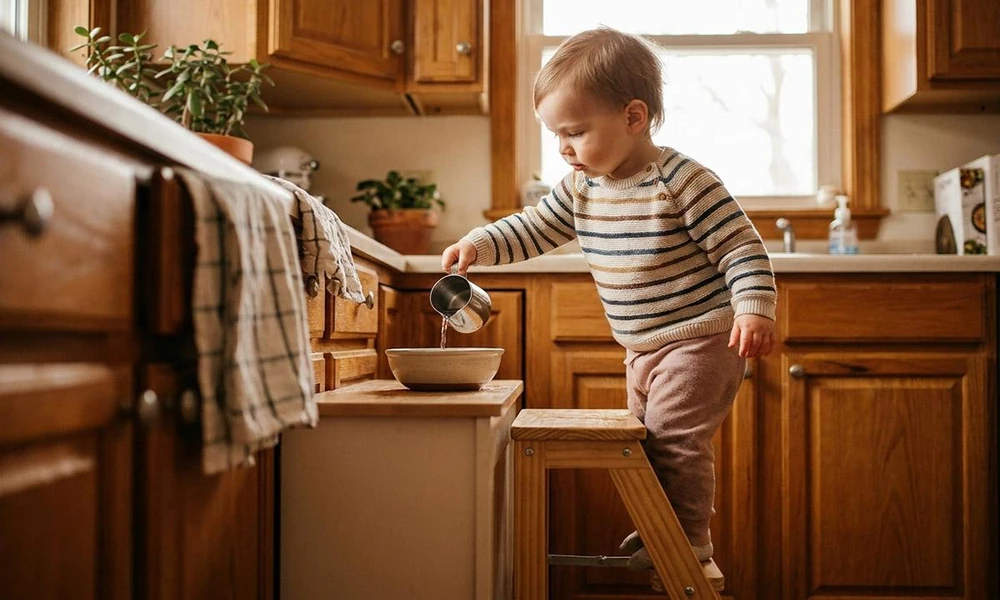
The kitchen is one of the easiest rooms to bring Montessori ideas into, because the tasks are already real. A small pitcher for pouring water, a low step stool at the counter, and a basin for washing produce can turn ordinary chores into activities your child can genuinely do, not just watch you do.
Pouring is a wonderful starting point. A small, unbreakable pitcher with a little water lets a two- or three-year-old practice pouring their own drink at snack time, spills and all. Both the American Montessori Society and AMI/USA describe these hands-on kitchen tasks as some of the most motivating work for young children because the result is immediate and useful.
A step stool at the sink turns handwashing and dish-rinsing into something your child can manage alone. Washing a few strawberries or tearing lettuce for a salad works the same way. These are not busywork chores. They are real contributions to the household, sized for a small person.
You can also set up a simple snack station on a low shelf in the kitchen: a few crackers in a small container, a stack of child-sized plates, and a pitcher for water. When a preschooler can serve their snack after school, it removes one more moment of the day where they need to wait for an adult.
The Bathroom and Entryway: Small Swaps for Big Independence
Two of the most overlooked spots in the house are the bathroom and entryway, and both respond well to small changes. A step stool at the sink lets your child brush their teeth and wash their hands without needing to be lifted up. A low hook by the door lets them hang up their jacket or backpack when they get home.
HealthyChildren.org, the American Academy of Pediatrics’ parenting resource, notes that age-appropriate chores like these build a real sense of responsibility in young children, not just tidiness. A toddler who can reach the towel bar and hang up their coat is practicing the same independence skills that carry over into preschool and beyond.
None of these tasks requires new furniture. A step stool from any home store and a hook installed at child height are often enough.
A basket by the door for shoes, sized so your child can find their own pair without help, rounds out the entryway. Small as it sounds, most preschoolers take genuine pride in being able to put on their shoes before a trip to the park.
Toy Rotation in a Montessori Home Environment: Doing More With Less
Toy rotation means keeping only a handful of toys out at a time and storing the rest away, then swapping in a “new” set every few weeks. The American Montessori Society points to fewer visible choices as a way to help children focus, finish an activity, and play more creatively instead of grazing from one toy to the next. Most families start with five to eight toys on a shelf at once.
The logic is simple. A shelf crowded with twenty toys often leads to a child picking something up and putting it right back down. A shelf with six well-chosen toys tends to hold attention longer.
Every few weeks, swap in different toys from storage bins. Nothing needs to be new. The rotation itself is often what makes an old toy feel fresh again.
Labeled bins in a closet make rotation manageable for busy parents. When a toy set comes off the shelf, it goes straight into its bin, ready to swap back in later. Over time you will notice which toys your child returns to again and again, which is useful information for what to keep in steady rotation.
Fewer toys out at once often means longer, deeper play, not less of it.
Bringing Your Montessori Home Environment Together: Start Small and Build Over Time
You do not need to overhaul your whole house in one weekend. Pick one shelf, one drawer, or one corner and start there. Zero to Three’s research on independent play and NAEYC’s guidance on choice-making both point to the same conclusion: consistency in one small space matters more than a perfectly designed room.
Once one area feels natural, whether that is the bedroom shelf or the kitchen step stool, add another. Over a few months, these small changes create a home that supports the same kind of independence your child is building in the classroom.
It also helps to involve your child in the process. Ask a preschooler which shelf they would like to set up next, or let a toddler help carry books to their new low shelf. Their input, even in small doses, makes the space feel like theirs rather than something done to them.
If you would like to see how these habits continue in a full school day, our curriculum page walks through how Toddler and Primary classrooms build on exactly this kind of independence. You can also learn more about our teachers and approach on our About Us page.
Setting up a home like this is less about following a checklist and more about noticing where your child keeps getting stuck and clearing that one obstacle. Some weeks that means a shelf. Other weeks it means a step stool by the sink. Every child develops at their own pace, and this article is meant as general educational information, not a guarantee of specific skills or timelines.
Curious what a Montessori day actually looks like for your child? Come see it in person. KV Montessori Academy welcomes families in Eastlake and Chula Vista to tour our classrooms and meet our teachers. Schedule a Tour or call (619) 730-4020.
Frequently Asked Questions
Do I need to buy special Montessori furniture to set up my home?
No. Most Montessori-inspired changes at home use furniture and items you already own, lowered or rearranged so your child can reach them. A short bookshelf, a kitchen step stool, or a cleared-out drawer works just as well as purpose-built Montessori furniture. Start with what is already in your house before buying anything new.
How many toys should a toddler have out at once?
Many families find that five to eight toys on a shelf works well for toddlers, though the right number depends on your child and your space. The goal is fewer, well-chosen options rather than a toy box a child has to dig through. You can always rotate in different toys every few weeks to keep things feeling fresh.
What age should I start setting up a Montessori home environment?
You can begin as soon as your child is mobile, often around 12 to 18 months, with simple changes like a low shelf or a childproofed corner. The specific setup will change as your child grows, moving from a floor bed and a few toys for a toddler to a small desk or art shelf for a preschooler. There is no single “right” age to start, only a right next step for where your child is now.
Is a floor bed safe for a toddler?
A floor bed can be safe if the room is childproofed, since the goal is for your child to get up and move around safely on their own. Cover outlets, secure furniture to the wall, and remove small or sharp objects from reach before trying one. If you are unsure, a low toddler bed with a guard rail is a fine alternative that offers some of the same independence.
How is a Montessori home environment different from just organizing toys?
Organizing toys is about tidiness, while a Montessori home environment is about independence. The goal is not just a neat shelf but a space where your child can choose an activity, use it, and put it away without needing help each time. That shift, from “clean up after your child” to “set up so your child can do it themselves,” is the main idea.